
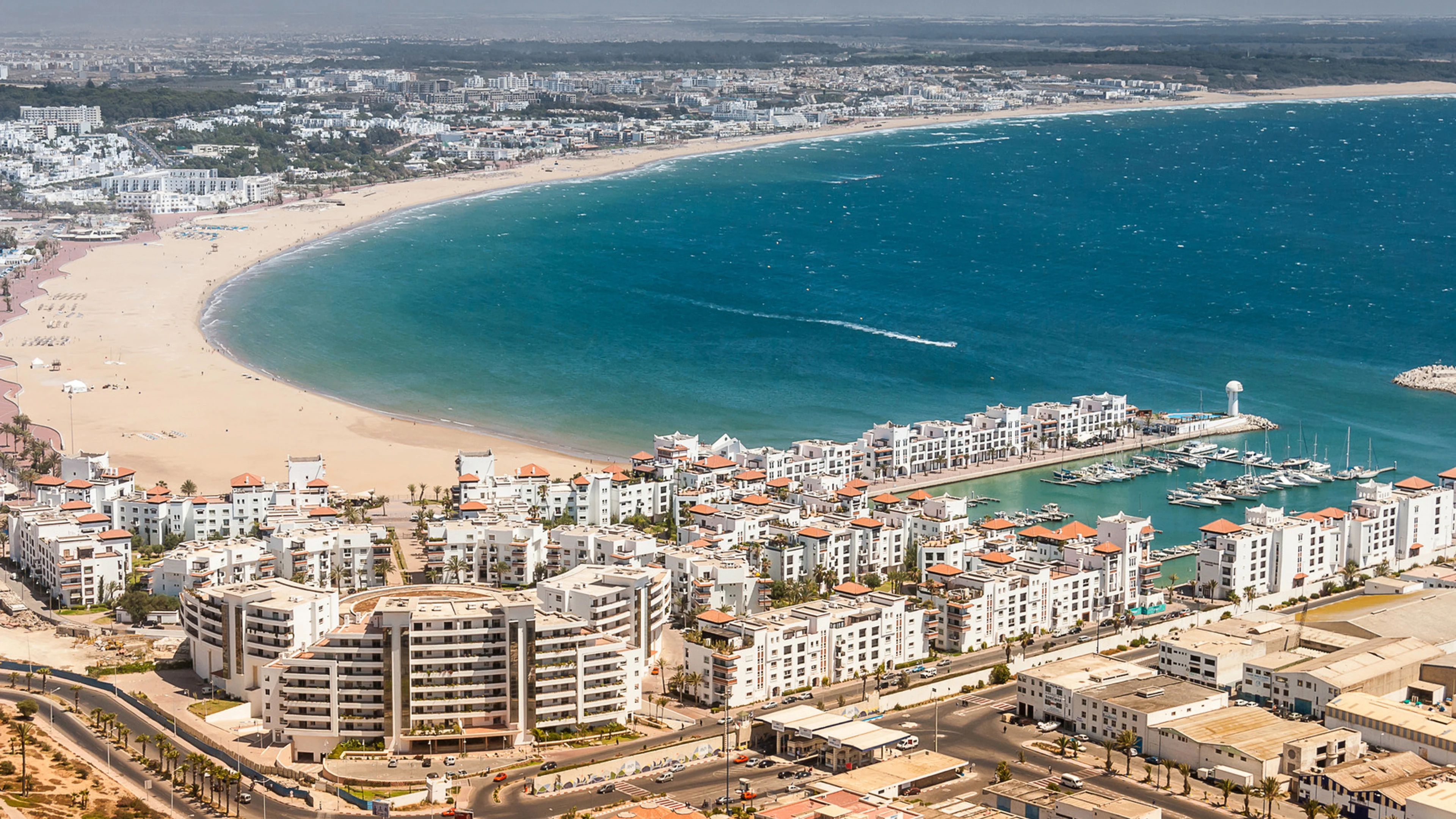
Agadir, Morocco, one of the country's best-known beach cities, curves around a wide Atlantic bay in the Souss region, about 250 km south-west of Marrakech. Rebuilt after the earthquake of 1960, it trades medina lanes for a long sandy beach, a seafront promenade and a mild coastal climate. Use it as a sunny base for Taghazout's surf, the palm-lined gorge of Paradise Valley, walled Taroudant and the birdlife of Souss-Massa National Park, ideally with a private driver.
Things to do in Agadir, and why go
Agadir is a place to slow down. After the medinas and the desert, its beach, sea air and easy pace make it a natural last stop, and a good base for the coast and countryside around it.
- The beach and promenade. A long sandy bay lined with hotels, with a seafront walkway for evening strolls.
- Agadir Oufella. The hilltop kasbah site above the port, built in the 16th century to guard the bay, gives the widest view over the city and the sea.
- The story of the city. In 1960 two earthquakes, a tidal wave and fire killed about 12,000 people and left Agadir largely destroyed; a new center was built to the south of the old town, which explains the city's modern look.
- Surf and watersports. Taghazout, a small fishing village and surf destination, lies about 20 km north along the coast.
- Argan country. The Arganeraie, Morocco's first UNESCO biosphere reserve, declared in 1998, covers the argan woodland of the surrounding region, and argan oil is an emblem of Moroccan body-care tradition.
The climate is a draw in itself. Average daily temperatures in Morocco's coastal cities run about 18 to 28 °C in summer and 8 to 17 °C in winter, which makes Agadir appealing in the cooler months.
How long should you stay in Agadir?
Two or three nights suit most travelers adding the coast to a trip inland, and a week suits a beach holiday with day trips. Agadir works well at the end of a route, when a few unplanned days by the sea feel earned.
With two nights, give one day to the beach and Agadir Oufella, and the other to Taghazout or Paradise Valley. With four or five nights, add Taroudant and Souss-Massa National Park, or continue up the coast to Essaouira for a night or two.
How do you get to Agadir?
Agadir Al Massira Airport (AGA) lies about 25 km south-east of the city, so every arrival ends with a road transfer to the beach hotels; UK travel advice notes that cars booked through ride-hailing apps may be unlicensed and uninsured. By road, Marrakech is about 250 km away, 2.5 to 3 hours on the A7 motorway, and Essaouira about 175 to 185 km north along the coastal N1, a little over three hours without stops.
Agadir is also a good base for the south-west, and its sights spread in every direction:
| Trip from Agadir | How far | Best for |
|---|---|---|
| Taghazout | About 20 km north | Surf lessons, cafés and sunsets |
| Paradise Valley | Inland, in the hills behind the coast | Rock pools, palms and short walks |
| Souss-Massa National Park | South of the city, along the coast | Birdlife at the river estuaries, including the northern bald ibis |
| Taroudant | About 80 to 85 km east, around 1.5 hours | Earthen ramparts and souks |
| Essaouira | About 175 to 185 km north, a little over 3 hours | A UNESCO-listed walled port, better with a night |
| Marrakech | About 250 km, 2.5 to 3 hours | The medina, as a long day or an onward leg |
What does a private driver or guide add in Agadir?
The best of the region lies outside the city, and the distances are just long enough to make a car essential. A private driver links the airport, the beach hotels and the excursions, waits while you walk in Paradise Valley or explore Taroudant, and can pause on the coast road at a viewpoint or a beach café. That flexibility also suits families and travelers with surfboards or bulky bags.
A licensed guide adds depth in the walled towns. In Taroudant, a guide explains the ramparts and the souks; in Essaouira, the history of Mogador and its traders. Guiding is a regulated profession in Morocco, and natural-spaces guides lead mountain walks if you want to hike in the hills inland. Away from the beach, dress modestly in villages and towns, and ask before photographing people.
Private tours and transfers for Agadir
Choose a starting point, and Morocco Royale can plan the rest of your days on the coast.
- The Agadir private tour for the city, the coast and the countryside around it.
- Agadir airport transfers for arrivals and departures.
- The Essaouira day trip for the walled port to the north.
- The private Marrakech day tour if your route continues inland.
Browse all Morocco destinations, private tours in Morocco, private transfers and luxury Morocco tours, or plan your Morocco trip from the start. The neighboring city guides cover Essaouira and Marrakech.
Frequently asked questions
Is Agadir worth visiting for more than the beach?
Yes. Beyond the bay, Agadir is a base for Taghazout's surf, the rock pools of Paradise Valley, the earthen ramparts of Taroudant and the birdlife of Souss-Massa National Park. The hilltop kasbah site of Agadir Oufella also tells the story of the 1960 earthquake that reshaped the city.
How far is Agadir from Marrakech?
About 250 km by road, or 2.5 to 3 hours on the A7 motorway, which crosses the western end of the High Atlas. A private transfer takes you from a medina gate in Marrakech to your hotel door in Agadir, with stops along the way if you ask.
How far is Taghazout from Agadir?
Taghazout lies about 20 km north of Agadir along the coast road, a short drive from the city's hotels. The airport is on the other side of the city, about 25 km to the south-east, so arrivals heading straight to Taghazout should allow extra time for the transfer.
Is Agadir, Morocco warm in winter?
Agadir is mild rather than hot in winter. Average daily temperatures in Morocco's coastal cities run about 8 to 17 °C in the colder months, so days are often pleasant for walking and sightseeing, though evenings call for a layer.
Why does Agadir look so modern?
In 1960, two earthquakes, a tidal wave and fire left the old city largely destroyed and killed about 12,000 people. A new city center was then built to the south of the old town, so most of Agadir dates from after the disaster. The ruins of the hilltop kasbah at Agadir Oufella recall the earlier city.