
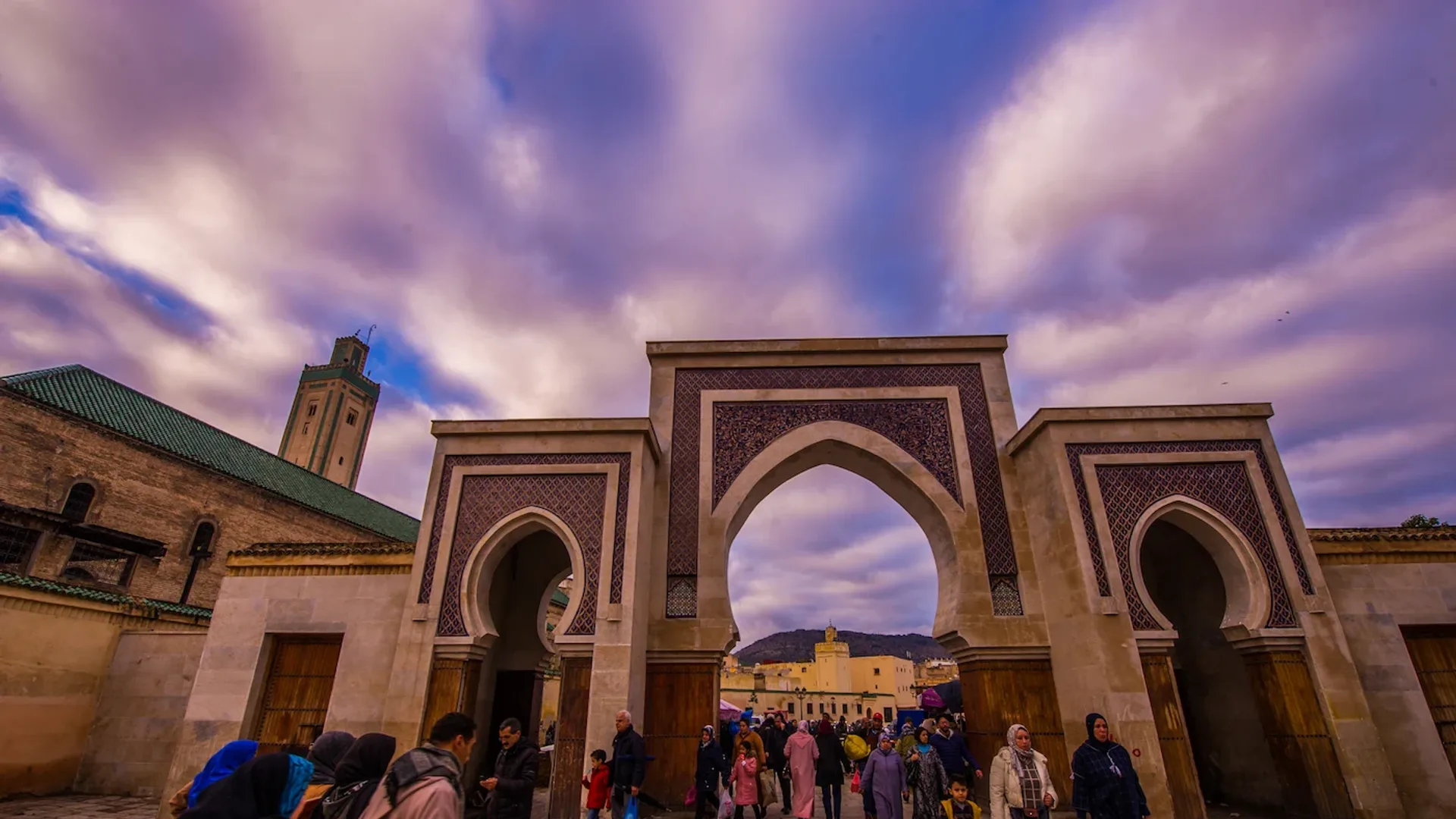
The Bou Inania is the largest and most sumptuous of the Marinid madrasas of Fes, built between 1350 and 1355 under Sultan Abu Inan Faris, whose name it carries. Unlike the other colleges of the medina, it was conceived as a full congregational mosque as well as a teaching institution, complete with its own minaret and a green-tiled prayer hall across a marble courtyard — which is why it remains one of the very few active religious buildings in Morocco that non-Muslims are allowed to enter.
The decoration is the Marinid style at its most complete: a dado of intricate zellij mosaic, above it panels of finely carved white stucco, and above those a crown of dark cedar worked into geometric and calligraphic friezes. A stream of the Oued Fes runs beneath the building, and across the alley outside stands the famous water clock — a row of thirteen brass bowls and wooden beams whose original chiming mechanism has puzzled restorers for centuries.
The madrasa sits just inside Bab Bou Jeloud on Talaa Kebira, one of the medina's busiest lanes. A private guided tour times your visit around prayer hours (when it closes to visitors), explains what you are looking at, and links it in one unbroken walk with the Blue Gate and the souks rather than leaving you to find it alone.
Highlights
- The marble courtyard framed by carved cedar, stucco and zellij
- A working congregational mosque with its own minaret — rare public access for non-Muslims
- The green-tiled prayer hall glimpsed across the courtyard
- The famous Bou Inania water clock on the lane opposite
- A branch of the Oued Fes running beneath the building
- A prime position just inside the Blue Gate on Talaa Kebira
Best Time to Visit
Late morning outside the midday prayer, when the courtyard is open to visitors and the sun lights the cedar and stucco.