
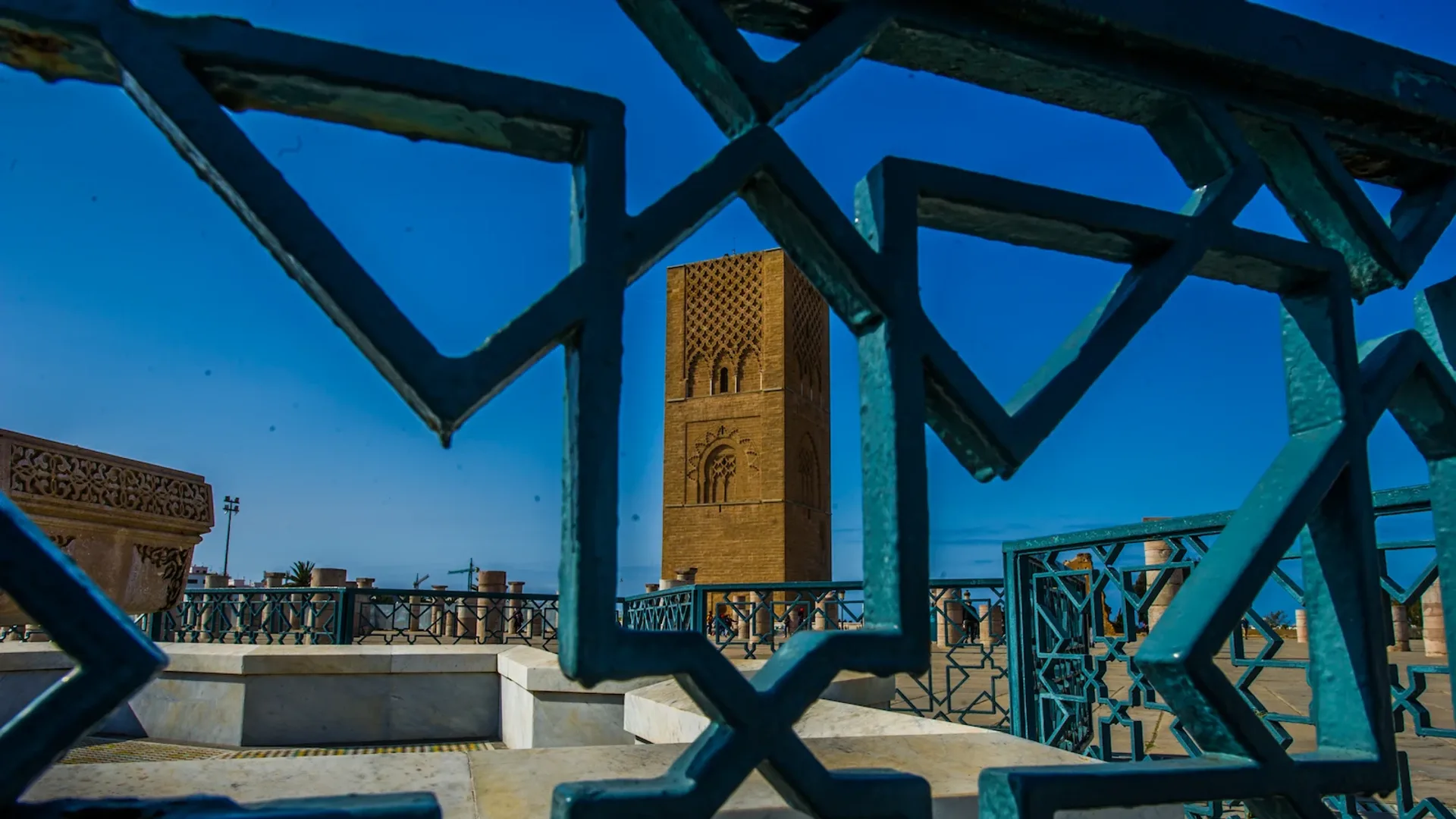
The Hassan Tower is the enduring icon of Rabat — a great red-sandstone minaret begun in 1195 by the Almohad sultan Yacoub al-Mansour, who set out to build the largest mosque in the western Muslim world. When he died in 1199 the work stopped, and the tower was left at about 44 metres, roughly half its intended height, its top storeys never raised.
What survives is strangely powerful: the massive square minaret, its four faces each carved with a different pattern of blind arches and interlacing motifs, presiding over a wide esplanade studded with the stumps of some 200 columns and the low remains of walls that were meant to hold the vast prayer hall. Unlike most minarets, it was designed with internal ramps rather than stairs, so the muezzin could ride a horse to the top. The 1755 Lisbon earthquake toppled much of what stood; the columns you see today were re-erected during 20th-century restoration.
The esplanade is open and free to visit, and it sits directly across from the Mausoleum of Mohammed V, so the two are naturally seen together. A private driver brings you straight to the site — handy given its position on the slope above the river — and can pair it with the mausoleum and the kasbah in a single unhurried loop rather than a series of taxi hops.
Highlights
- The 44-metre unfinished Almohad minaret of 1195, carved on all four faces
- The forest of re-erected columns marking the never-completed prayer hall
- Ceremonial royal guards on horseback flanking the esplanade
- The paired setting facing the Mausoleum of Mohammed V
- Views down over the Bouregreg river toward Salé
- Part of the UNESCO-listed historic core of Rabat
Best Time to Visit
Morning light catches the red sandstone best; visit early to explore the open esplanade before the heat and coach parties arrive.