Rabat Travel Guide: Morocco's Underrated Capital
Rabat is the capital most travellers skip — and that is exactly why it works. Morocco's seat of government is calm, coastal and quietly beautiful, with imperial-era monuments, a relaxed medina and almost none of the hustle you meet elsewhere. UNESCO listed the city in 2012 for the way its 12th-century landmarks and 20th-century new town sit side by side, yet Rabat still receives a fraction of the visitors that Marrakech and Fes absorb. If your route touches the Casablanca–Tangier corridor, it deserves a full day.
Why Rabat deserves a full day
Rabat has been Morocco's capital since 1912, and it shows in the best possible way: broad boulevards, a modern tram, embassies behind bougainvillaea, and public spaces that are actually maintained. For a visitor, the practical pay-off is huge. The main sights sit close together along the Bou Regreg river, traffic is manageable, and shopkeepers let you browse without a sales pitch. A day here feels unhurried in a way Marrakech rarely does.
The city rewards a plan, though, because its four headline sights — the Kasbah of the Udayas, Hassan Tower, Chellah and the medina — form a loose arc rather than a single cluster. Our private driver tours in Rabat start at 2,400 MAD per vehicle for up to nine guests, which covers the car, fuel and an English-speaking driver for the day, with free cancellation up to 24 hours before pickup.
Kasbah of the Udayas
Start at the Kasbah of the Udayas, the 12th-century Almohad citadel guarding the mouth of the Bou Regreg. Enter through the monumental Bab Oudaia gate, then wander lanes painted blue and white in a palette that predates Chefchaouen's fame. The Andalusian Gardens inside the walls are a shaded pocket of orange trees and cats, and the platform at the far end looks across the river mouth to Salé and out over the Atlantic surf.
Finish at the clifftop café with a mint tea and a plate of cornes de gazelle. Allow 60–90 minutes; mornings are quietest, and the light on the white walls is best late in the day.
Hassan Tower and the Mausoleum of Mohammed V
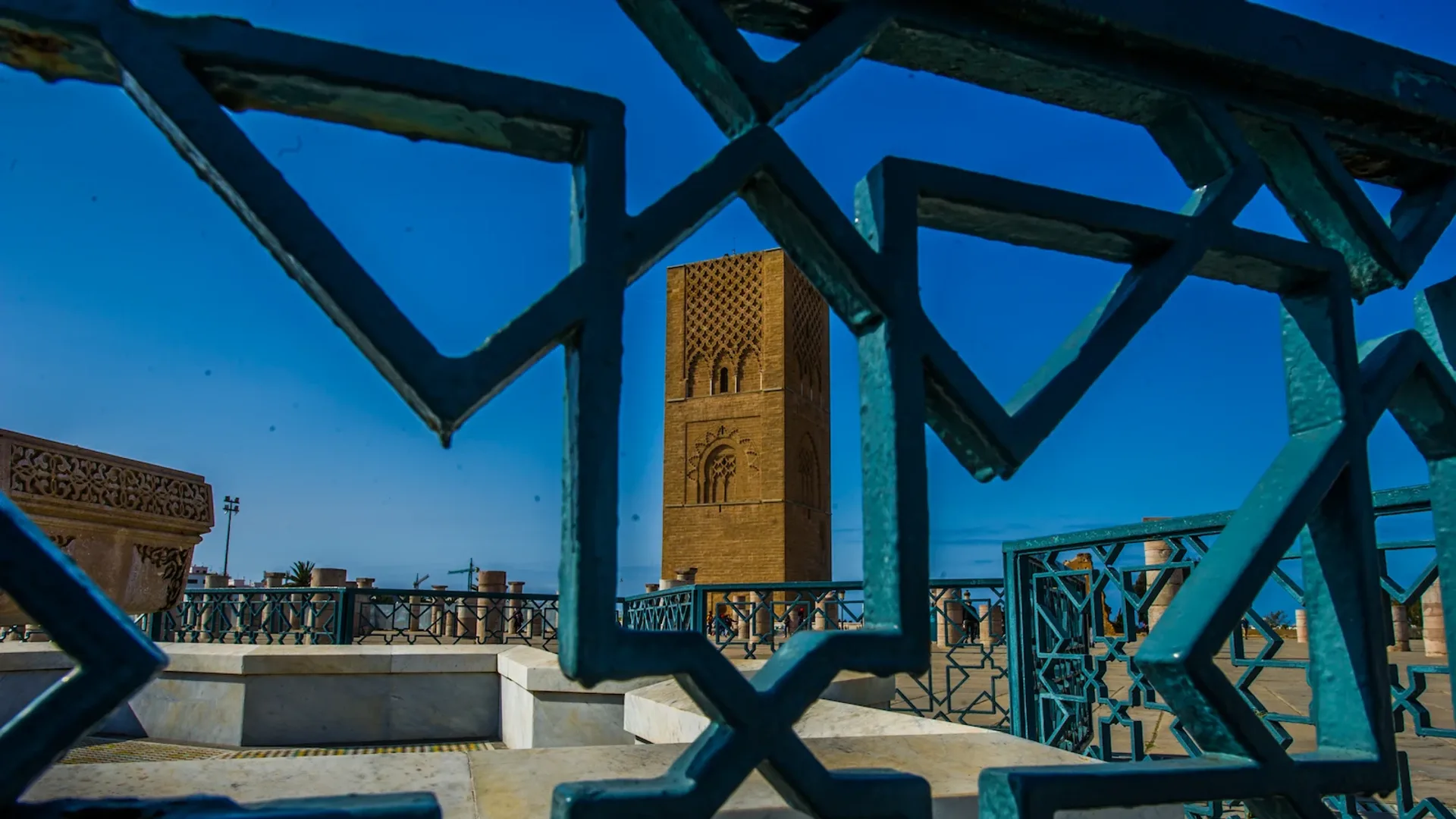
Hassan Tower is what remains of one of medieval Islam's most ambitious projects: a mosque begun in the 1190s that was meant to be among the largest in the world. The sultan died, the works stopped, and what survives is a 44-metre unfinished minaret standing over a field of broken columns — an oddly moving sight, patrolled by royal guards on horseback.
Across the esplanade is the Mausoleum of Mohammed V, resting place of the current king's grandfather and one of the few royal-religious buildings in Morocco that non-Muslims may enter. Entry is free, the craftsmanship inside is superb, and the guards at each door tolerate photographs with good grace. Note the contrast with Casablanca: at the Hassan II Mosque, non-Muslims can only enter on official guided tour slots at set times, something to plan around if you are pairing the two cities — see our Casablanca private tours.
Chellah: storks and Roman stones
Chellah is the sight visitors remember. A fortified Merinid necropolis from the 14th century sits on top of the ruins of Roman Sala Colonia, all of it half-swallowed by gardens and crowned by storks whose enormous nests top the old minaret. The site reopened after a careful restoration and remains wonderfully uncrowded; a modest entrance fee applies, payable on the day. Come in the last two hours before closing, when the light turns the stonework gold and the storks clatter their bills overhead.
The medina and Rue des Consuls
Rabat's medina is Andalusian in origin and almost grid-like by Moroccan standards, which makes it a gentle introduction if this is your first souk. Rue des Consuls is the classic artery — carpets, leather and silver, sold with minimal pressure and prices that open closer to reality than in the tourist capitals. As everywhere in Morocco, the souks go quiet around Friday midday prayers, so browse in the morning or late afternoon.
If you want the history unlocked as you walk, our Rabat walking tours with a licensed local guide start at 900 MAD for one to four guests (1,200 MAD for five to eight, 1,500 MAD for nine to thirteen), with free cancellation up to 48 hours ahead.
Planning a Rabat day? Tell us your dates, group size and interests on WhatsApp or through our contact page and we'll send a draft itinerary within 24 hours — no deposit, free cancellation up to 24 hours before a driver tour. Start planning your Rabat visit.
Across the river: Salé
Rabat's twin city is two minutes away by blue rowing boat across the Bou Regreg — still the most atmospheric crossing in Morocco for a few dirhams. Salé's medina is workaday and almost entirely local, its Great Mosque and 14th-century medersa are beautiful, and the riverside marina development below makes an easy walk back towards the bridge. An hour or two here rounds out the capital nicely.
Getting there and getting around
Rabat is one of the easiest Moroccan cities to reach. The Al Boraq high-speed line puts Casablanca under an hour away and Tangier around an hour and twenty minutes, with frequent standard trains filling the gaps. Within the city, the tram and short taxi hops cover everything, though a private driver removes the friction entirely and lets you sequence the arc of sights efficiently — Kasbah, medina, Hassan Tower, Chellah — in a single relaxed day.
Cruise passengers calling at Casablanca increasingly choose Rabat as their day ashore, and with reason: it is roughly 75–90 minutes each way and delivers a genuine imperial city without the long haul to Marrakech. Our Morocco cruise excursions guide covers the timings in detail.
When to visit
Rabat's Atlantic position keeps it temperate year-round: spring and autumn are ideal, and even midsummer stays far cooler than Marrakech or Fes. Pack a layer for breezy evenings on the kasbah. During Ramadan — which shifts about 11 days earlier each year — daytime cafés are subdued and the city turns festive after sunset; sights stay open with adjusted hours. Combine Rabat with Tangier for a northern coastal route, or browse all our tours to fit it into a longer itinerary.
Frequently asked questions
Is Rabat worth visiting?
Yes — especially as a counterweight to the intensity of Marrakech and Fes. It offers a UNESCO-listed kasbah, major Almohad and Merinid monuments, a hassle-free medina and Atlantic sea air, all in a clean, orderly capital that most tour buses drive straight past.
How many days do you need in Rabat?
One full day covers the big four sights comfortably. A second day adds Salé, the Mohammed VI Museum of Modern and Contemporary Art and time to simply enjoy the corniche and café life.
Can you combine Rabat and Casablanca in one day?
Yes. The cities are about an hour apart, and a private driver can pair the Hassan II Mosque's guided tour slot in Casablanca with an afternoon in Rabat's kasbah and Chellah. It is a full day but a very rewarding one.
Is Rabat safe for tourists?
Rabat is widely considered one of Morocco's most relaxed cities for visitors. Normal city awareness applies, but the hard sell and faux-guide hassle found in busier destinations is largely absent here.