
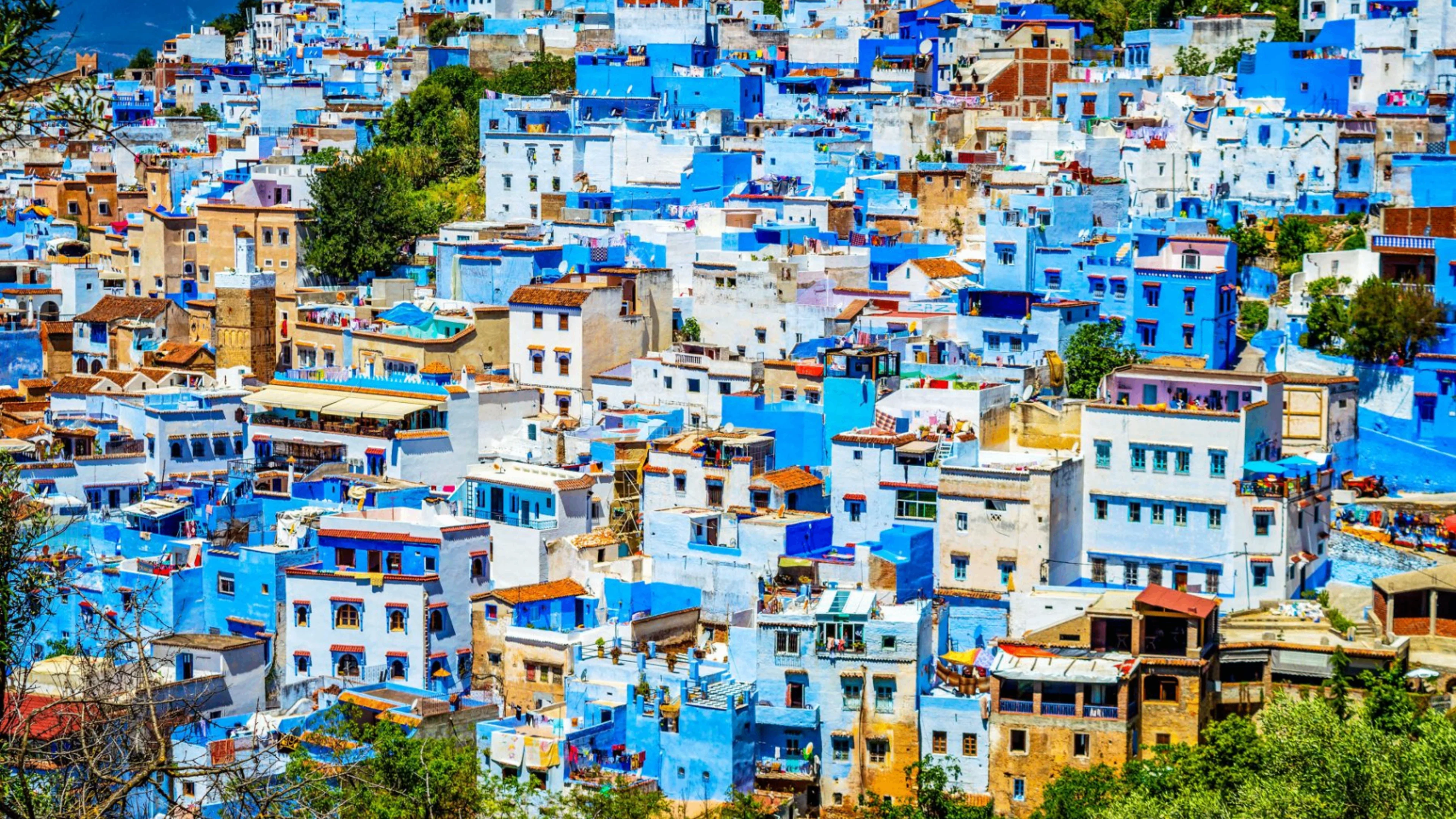
Chefchaouen, Morocco's blue-washed mountain town, sits in the Rif about 200 km north of Fes and 105 to 115 km south of Tangier. Its small medina of blue lanes, the kasbah on Outa el Hammam square and the walk up to the Spanish Mosque at sunset are best enjoyed over one or two nights rather than a rushed day trip. The town has no railway station, so you arrive by road, ideally with a driver who can stop in Tétouan on the way.
Why visit Chefchaouen, Morocco?
Chefchaouen is famous for its blue-washed lanes, and its history explains its Andalusian feel. It was founded in 1471 as a holy town at the foot of the mountains and later became a refuge for Moors expelled from Spain. Spanish forces occupied it in 1920 and returned it to Morocco in 1956, and Spanish is still common across the north alongside Darija and French.
The pleasures here are small and slow:
- The blue lanes. Stepped alleys, doorways and walls washed in every shade of blue, best seen in soft morning or evening light.
- Outa el Hammam square. The heart of the medina, lined with cafés and overlooked by the clay-colored kasbah.
- The kasbah. Its walls enclose an Andalusian-style garden and a small ethnographic museum, and its tower gives views over the rooftops.
- Ras el-Ma. The spring and small waterfall just outside the medina's north-eastern gate, where the path into the hills begins.
- The Spanish Mosque. A hilltop mosque built by the Spanish in the 1920s and never used for worship; its terrace is the classic sunset viewpoint over the town.
Beyond the town, the Rif offers walking country, including the waterfalls at Akchour, a popular outing that combines a drive with a hike.
How long should you stay in Chefchaouen?
One night is the minimum that does the town justice, and two suit anyone who wants to hike. Chefchaouen is compact, so its sights fit into a day; what an overnight stay buys you is the town early and late, when the lanes are quiet and the light flatters the blue walls.
| Plan | Time in Chefchaouen | Who it suits |
|---|---|---|
| Day trip from Fes | A few hours, after 3.5 to 4 hours each way | Travelers short on nights |
| Day trip from Tangier | Half a day, after about 2 hours each way | Visitors based in the north |
| One night between Fes and Tangier | An afternoon, evening and morning | Most first-time visitors |
| Two nights | Town, viewpoints and a hike in the Rif | Walkers and photographers |
Breaking the journey between Fes and Tangier here is the most natural plan. It turns two long drives into two comfortable half days and puts you in the medina at its quietest.
How do you get to Chefchaouen?
Chefchaouen is reached by road only. There is no railway station; the nearest train services run from Tangier and Fes. The nearest airports are Tangier Ibn Battouta (TNG) and Fès–Saïss (FEZ).
- From Fes: about 200 km, 3.5 to 4 hours through the Rif foothills.
- From Tangier: about 105 to 115 km, roughly 2 hours.
- From Tétouan: about 60 to 75 km, 1 to 1.5 hours. Tétouan's medina has been on UNESCO's World Heritage List since 1997, so it makes a rewarding stop on the way from Tangier.
The mountain roads wind, so allow for slower stretches and stops for views.
What does a private driver or guide add in Chefchaouen?
A private driver solves the main problem: getting there. With no train and long bus connections, a driver lets you leave when you like, stop in Tétouan or at a viewpoint, and keep your luggage with you between Fes, Chefchaouen and Tangier. That is especially useful if you are linking the north to Fes or catching a ferry or train in Tangier.
In town, a licensed local guide adds the stories behind the walls: the Andalusian refugees, the kasbah and the Spanish period. Guiding is a regulated profession in Morocco, with a separate license category for natural-spaces guides who lead mountain walks, so ask for one if you plan to hike in the Rif. Residents live behind those photogenic doors, so ask before photographing people or stepping onto a doorstep for a picture.
Private tours and transfers for Chefchaouen
Start from one of these, and Morocco Royale can build the drive and the nights around it.
- The Chefchaouen private tour for the blue town itself.
- Private transfers from Tangier for the road south from the port, airport or station.
- In Fes, the Fes private day tour and the Fes medina walking tour, or the Tangier private tour at the northern end.
- The imperial cities private tour for a longer loop through the north.
For more ideas, browse all Morocco destinations, private tours in Morocco, private transfers and luxury Morocco tours, or plan your Morocco trip. The neighboring city guides cover Fes and Tangier.
Frequently asked questions
Is one day enough in Chefchaouen?
One day is enough to see the medina, the kasbah and the Spanish Mosque viewpoint, but a day trip spends 4 to 8 hours on the road, depending on your starting point. A single night removes that pressure and gives you the quiet lanes in the evening and early morning.
Can you visit Chefchaouen from Tangier in a day?
Yes. Chefchaouen is about 105 to 115 km from Tangier, roughly 2 hours each way, so a long day trip works, especially with a stop in Tétouan. If your route continues to Fes, staying the night in Chefchaouen splits the drive into two easy legs.
Does Chefchaouen have an airport or a train station?
Neither. The closest airports are in Tangier and Fes, and the nearest train services also run from those two cities. From there you continue by road, either by bus, shared taxi or private transfer, which is the most flexible option with luggage.
What language is spoken in Chefchaouen?
Darija, Moroccan Arabic, is the everyday language, as elsewhere in Morocco. French is widely understood, and Spanish is common in the north, a legacy of the Spanish period. English is growing in hotels, cafés and shops used to visitors.
Is it polite to photograph people in Chefchaouen?
Photograph the lanes freely, but ask before taking pictures of people, and respect signs or requests to keep away from private doorways. Many of the blue houses are family homes, and a quick question or a smile goes a long way.