
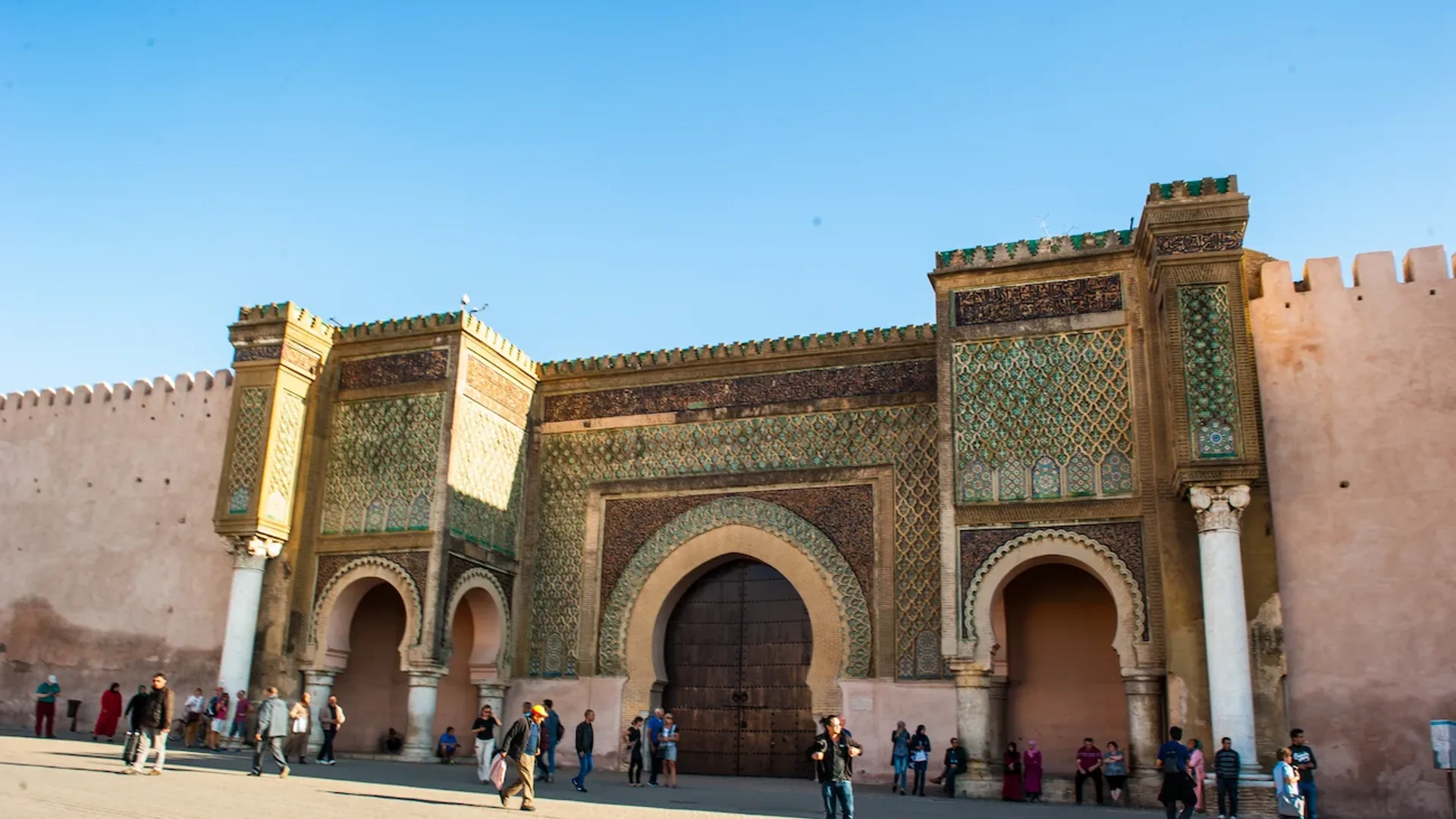
Bab Mansour is widely regarded as the most monumental gateway in Morocco, and arguably in all of North Africa. Commissioned by Sultan Moulay Ismail and completed around 1732 under his son Moulay Abdallah, it marked the ceremonial threshold between Place el-Hedim and the sultan's imperial city. The gate takes its name from its architect, El-Mansour, a Christian convert to Islam, and its scale was deliberate: a sultan who had built one of the great imperial capitals wanted an entrance to match.
The facade is a lesson in Moroccan-Andalusian design. A broad horseshoe arch is framed by intricate green-and-white zellij tilework and bands of carved Arabic inscription, all flanked by two projecting bastions that rest on recycled marble columns taken from the Roman ruins at nearby Volubilis. The tilework has faded and mellowed over three centuries, which only adds to its character in the low light of morning and late afternoon.
The gate is admired from the outside on Place el-Hedim and is free to view at any hour; the interior is sometimes opened for temporary exhibitions but is not a fixed attraction. Because Meknes sees far fewer tour buses than Fes or Marrakech, a private driver can drop you at the square directly and time the visit for the softer light, sparing you the long walk in from the parking areas outside the medina walls.
Highlights
- The towering central horseshoe arch framed by green-and-white zellij mosaic
- Marble columns at the base of the bastions salvaged from Roman Volubilis
- Carved Kufic and cursive inscription bands running across the facade
- The full sweep of Place el-Hedim opening directly in front of the gate
- Golden late-afternoon light that warms the aged tilework for photography
Best Time to Visit
Early morning or the hour before sunset, when low sun lights the tilework and Place el-Hedim is at its calmest.