
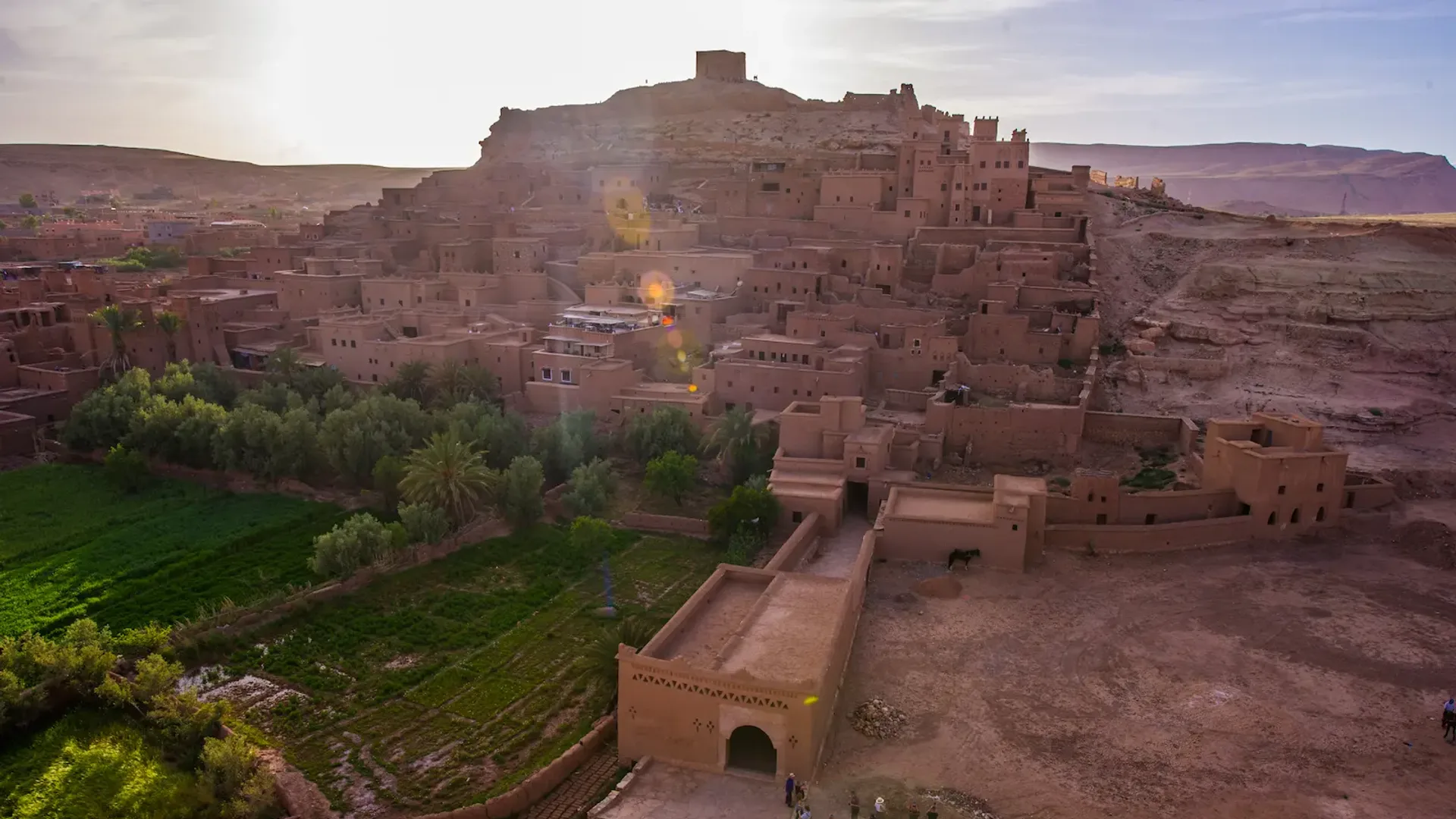
Ait Benhaddou is a fortified village, or ksar, of earthen kasbahs stacked up a hillside above the Ounila river, about 30 kilometres northwest of Ouarzazate. Built from rammed earth, mud brick and straw, its cluster of towers with their crenellated corners and decorative geometric patterns is the most complete surviving example of southern Morocco's pre-Saharan architecture. It has been on the UNESCO World Heritage list since 1987.
Once a stop on the caravan route between the Sahara and Marrakech, the ksar is now largely uninhabited — only a handful of families still live inside the walls, while most locals have moved to the modern village across the river. To reach the old town you cross the riverbed (usually a shallow trickle or dry, with stepping stones and, in higher water, a small crossing point) and climb the earthen lanes to the agadir, or communal granary, at the summit, where the view stretches across the palm groves and the Anti-Atlas foothills.
Ait Benhaddou is also one of the world's most filmed locations, standing in for ancient cities in Lawrence of Arabia, Gladiator, Kingdom of Heaven, The Mummy and Game of Thrones, among many others. A private driver makes the visit straightforward: it sits off the main Ouarzazate road, and being dropped at the entrance lets you arrive early or late to walk the ksar before or after the tour-bus crowds, without worrying about the return trip.
Highlights
- The climb through the earthen lanes to the hilltop agadir (communal granary) for panoramic views
- The crenellated corner towers and geometric relief patterns on the kasbah walls
- Crossing the Ounila riverbed to reach the old ksar from the modern village
- Film-location spots used in Gladiator, Lawrence of Arabia and Game of Thrones
- Artisan and craft stalls tucked into restored houses along the way up
- Sunset light turning the mud-brick walls deep gold from the far riverbank
Best Time to Visit
Arrive early morning or in the late afternoon golden hour to catch soft light on the mud walls and avoid the midday coach groups; spring and autumn offer the most comfortable temperatures.