
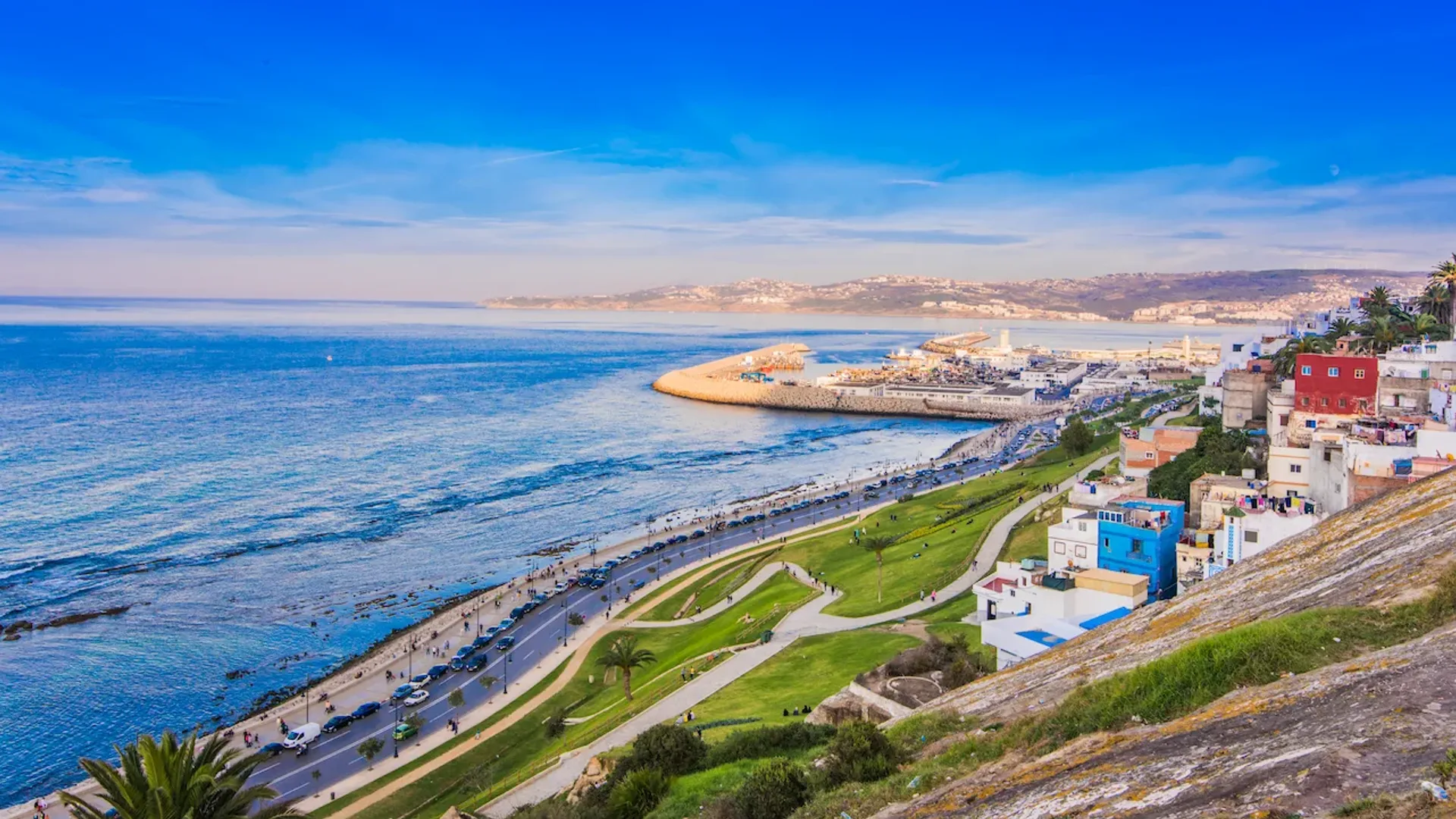
Tétouan sits in the foothills of the Rif mountains, about 60 kilometres east of Tangier and close enough to the Mediterranean to be a short drive from its beaches. Its medina, inscribed on the UNESCO World Heritage list in 1997, was largely rebuilt by Muslim and Jewish refugees expelled from Andalusia in the 15th and 16th centuries, and that Andalusian heritage still defines it: whitewashed houses with pastel trim and wrought-iron balconies, small tiled fountains, and a distinctly Spanish-Moorish sensibility rather than the Arab-Berber character of Marrakech or Fes.
Inside the walls the medina is compact, hilly and easy to explore, with an active souk built around specialised trades — jewellers, leatherworkers, weavers, cobblers — that still hold their traditional lanes rather than catering to tourists. The Royal Palace faces Place Hassan II at the medina's edge, and the surrounding streets are lined with cafés under Spanish-style arcades, a reminder that Tétouan was the capital of the Spanish Protectorate from 1913 to 1956 and that Spanish is still widely spoken here.
This is one of the least commercialised of Morocco's imperial medinas, which is much of its charm and also its practical challenge — signage is limited, English less common, and the alleys can confuse first-time visitors. A private driver and local guide make it simple: door-to-door from Tangier or Chefchaouen, a walking loop of the main quarters and the souk with context you would not pick up alone, and enough time on the ramparts to take in the Rif backdrop.
Highlights
- A UNESCO-listed medina rebuilt by Andalusian refugees in the 15th-16th centuries
- Whitewashed houses with pastel trim, tiled fountains and Moorish-Spanish detail
- Active craft souks — jewellery, leather, weaving — still in their traditional lanes
- The Royal Palace on Place Hassan II at the medina's edge
- Spanish-arcaded cafés reflecting the former Spanish Protectorate
- Rif mountain backdrop and easy pairing with Chefchaouen and Tangier
Best Time to Visit
Spring and autumn for mild Rif weather; mornings for the fullest souk activity, before the craft workshops close for the afternoon.