Fes Medina Walking Guide: 24 Hours in Fes el-Bali
One day in the Fes medina is enough — if you walk it in the right order. This hour-by-hour route threads Bab Boujloud, the madrasas, the souks and the Chouara tannery into a single satisfying loop, with sunset at the Merenid Tombs and dinner already sorted before you set out.
Three rules before you start
First: in Fes el-Bali, downhill means deeper in. The medina drains towards the river at its heart, so when you are lost — and you will be — walking uphill always returns you towards the gates. Second: when you hear "balak!" behind you, flatten against a wall; it means a loaded mule or handcart is coming through, and it has right of way. Third: ignore anyone who tells you a street or attraction ahead is "closed" — it is the oldest redirection trick in the medina, and it always ends at a shop.
Wear closed shoes with grip (the lanes are cobbled, worn and occasionally wet), carry small notes and coins, and download an offline map even though it will only half-work in the covered lanes. That is part of the fun.
08:30 — Breakfast at Bab Boujloud
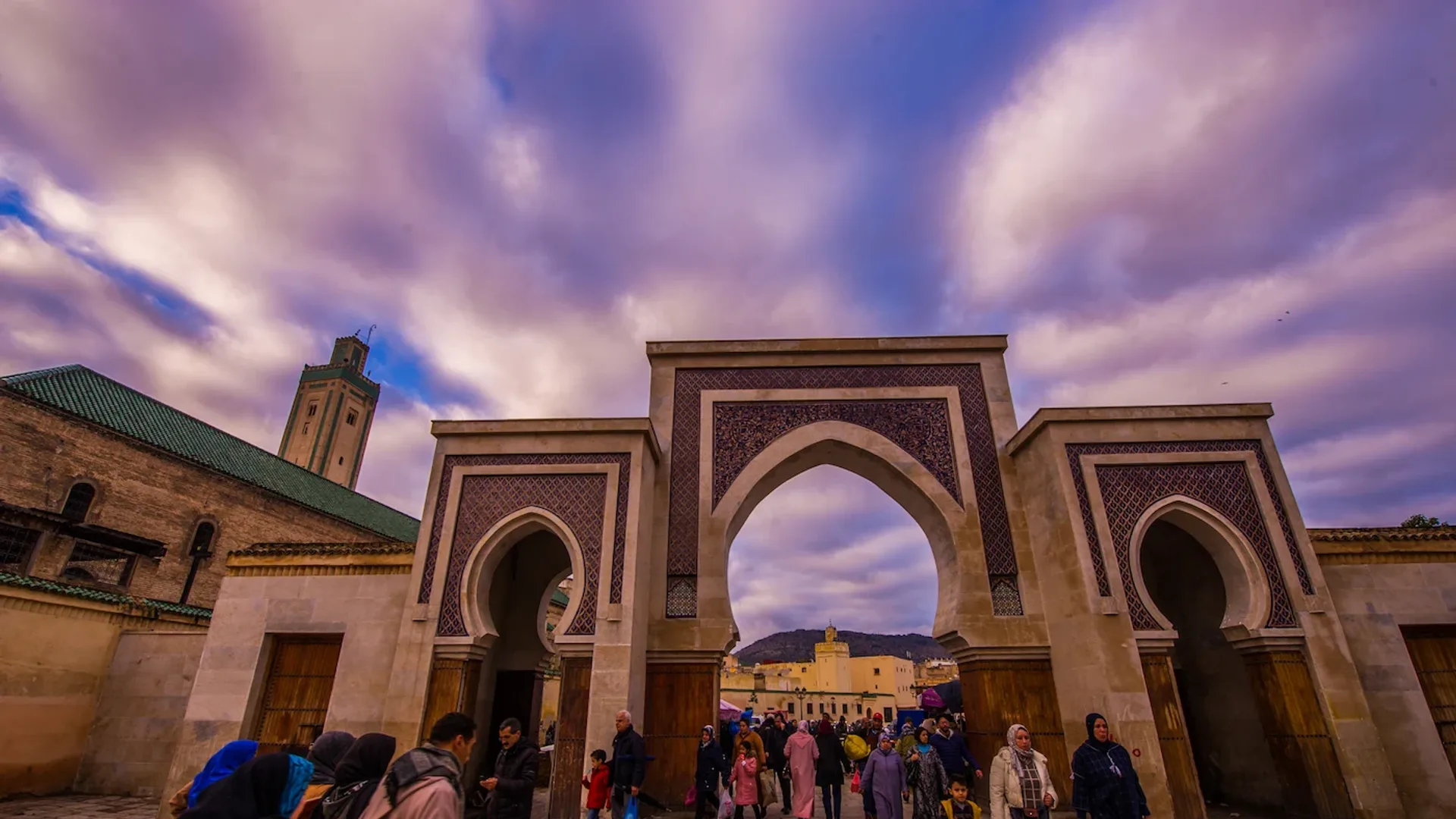
Start at the Blue Gate while the medina is still yawning. The cafés just inside serve b'ssara — the fava-bean soup Fassis swear by — for around 10 MAD, with msemen flatbread and mint tea. Watch the gate from a terrace: schoolchildren, handcarts and the first mules of the day all funnel through the same arch.
09:30 — Talaa Kebira and the Bou Inania Madrasa
Take Talaa Kebira, the medina's main artery, downhill. Two minutes in, the Bou Inania Madrasa is the morning's first masterpiece: a 14th-century Marinid college of carved cedar, sculpted plaster and zellij, open to non-Muslim visitors for about 20 MAD. Give it half an hour — the courtyard rewards standing still.
10:30 — Chouara tannery, while the morning shift works
Continue downhill through the souks towards the Chouara tannery. Mornings are the time to go: the pits are being worked, the light is good for photos and the smell is at its most manageable. You view the pits from the terraces of the leather shops that ring them — accept the sprig of mint, expect a sales pitch, and tip 10–20 MAD if you do not buy. The full playbook, including how the dye pits actually work, is in our Chouara tannery visiting guide.
Rather not navigate? Our Fes medina walking tour covers this exact ground with a licensed local guide who knows which funduq doors open on a knock — and who makes the tannery terraces pressure-free. Walking tours start at 900 MAD for one to four guests, with free cancellation up to 48 hours. Check availability or message us on WhatsApp via the contact page.
12:00 — Seffarine, al-Qarawiyyin and the oldest library in the world
From the tannery, work back towards Place Seffarine, where coppersmiths hammer pots in the open air exactly as their grandfathers did. The square sits against the walls of al-Qarawiyyin — founded in 859 and often called the world's oldest continuously operating university. Non-Muslims cannot enter the mosque, but its many doorways give honest views of the courtyard. One planning note: the souks fall quiet around Friday midday prayers, so if today is Friday, this stretch will be calm and half-shuttered until mid-afternoon — lovely for walking, useless for shopping.
13:00 — Lunch in the medina
Eat near Seffarine or back up towards Achabine street, where grill stands and hole-in-the-wall kitchens do brochettes, harira and stuffed msemen. A filling street lunch costs 40–80 MAD; a courtyard restaurant 100–150 MAD. Skip anywhere with a multilingual tout stationed outside.
14:30 — Al-Attarine Madrasa, the spice souk and Nejjarine
The Al-Attarine Madrasa (around 20 MAD) is smaller than Bou Inania and, many argue, finer — it was built at the entrance to the spice and perfume souk, so the sultan's best craftsmen worked where the money was. Then drift to the Nejjarine funduq, a restored merchants' inn housing the Museum of Wooden Arts and Crafts, on one of the medina's most photogenic little squares. The rooftop café view alone justifies the modest ticket.
16:30 — Jnan Sbil gardens and Fes el-Jdid
Exit the old medina and cross to Jnan Sbil, the 18th-century royal gardens — free, shaded and exactly what your feet want by now. Continue into Fes el-Jdid ("New Fes", a mere 700 years old) past the brass gates of the Royal Palace and through the Mellah, the old Jewish quarter with its distinctive wooden balconies.
18:00 — Sunset at the Merenid Tombs
End on the hill north of the medina, where the ruined Merenid Tombs overlook all of Fes el-Bali. At sunset the city turns gold and the call to prayer rises from hundreds of minarets at once — the best free show in Morocco. It is a stiff 25-minute walk up or a short petit-taxi ride; if you have a driver for the day through our private Fes tour, this is where they earn their keep.
20:00 — Dinner and the walk home
Book a riad dinner in advance — pastilla is the Fes order — and give yourself time for the lamplit walk back. The main arteries stay lively well into the evening; stick to them rather than shortcutting through dead-quiet side lanes, exactly as you would in any old city at night.
If you have a second day
Slow down and go deeper: the weavers' workshops around Ain Azliten, the potters' quarter outside the walls, a hammam (a scrub at a local bathhouse costs 50–100 MAD; upmarket spa versions from 300 MAD), or a half-day trip out — our Fes travel guide and Meknes and Volubilis day trip guide cover the options.
FAQ
Can you do the Fes medina without a guide?
Yes, with an offline map, comfortable shoes and tolerance for wrong turns — the route above is designed for it. A licensed guide changes the depth rather than the logistics: workshops open, stories attach to doorways, and touts evaporate. Many travellers do a guided morning first, then wander solo.
How long do you need in the Fes medina?
One full day covers the headline sights at a comfortable pace. Two days lets you add the artisan quarters, a hammam and the quieter northern lanes. As a pure minimum, a half day with a guide hits Bou Inania, the tannery and Seffarine.
Is the Fes medina accessible for prams or limited mobility?
Honestly, it is hard going: steep gradients, steps, cobbles and crowds. A baby carrier beats a pram every time. Travellers with limited mobility can still see highlights near the gates — Bab Boujloud, Bou Inania and Jnan Sbil — with taxi transfers between entrances.
What should I wear in the medina?
Comfortable closed shoes and modest, breathable clothing — shoulders and knees covered keeps things respectful and, in summer, cooler. A hat and water bottle in warm months; layers in winter, when Fes evenings bite.