Fes Travel Guide: Medina, Tanneries and Beyond
Fes is Morocco's oldest imperial city and its most rewarding puzzle: a 1,200-year-old medina of some 9,000 alleys where mules haul the freight and artisans still work by hand. Here is how to plan it properly — what to see, when to go, what things cost and how to keep the maze on your side rather than against you.
Why Fes deserves two nights, not a day trip
Marrakech gets the crowds; Fes keeps the craft. Fes el-Bali, the walled old city, is a UNESCO World Heritage Site and one of the largest car-free urban areas on earth. Nothing in it was arranged for visitors: the tanneries, coppersmiths, weavers and bakeries you pass are working businesses serving Moroccan customers first. That is exactly why it rewards patience. With one night you see the medina; with two you start to understand it — and you fit in the Merenid Tombs at sunset, a slow riad dinner and a morning visit to the tannery before the terraces fill up.
The sights that justify the hype
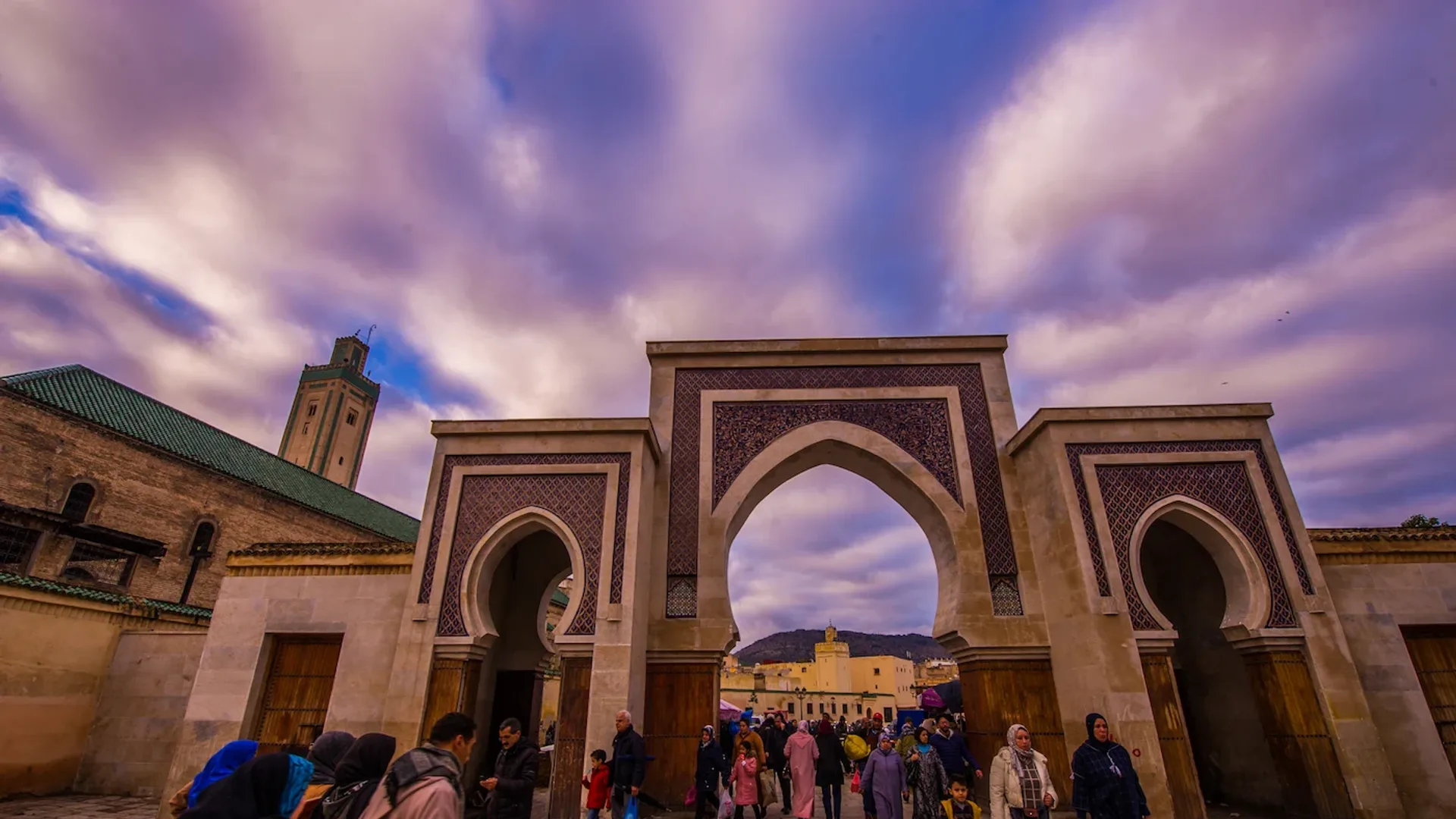
Bab Boujloud (the Blue Gate). The classic entrance to Fes el-Bali, tiled blue on the outside and green — the colour of Islam and of Fes — on the inside. The medina's two main arteries, Talaa Kebira and Talaa Sghira, run downhill from here, which matters: in Fes, downhill means deeper in.
Bou Inania Madrasa. A 14th-century Marinid theological college and one of the few religious buildings in Fes that non-Muslims can enter. Carved cedar, sculpted plaster and zellij tilework for a roughly 20 MAD entrance fee. Its rival, the smaller Al-Attarine Madrasa by the spice souk, is arguably even finer.
Al-Qarawiyyin Mosque and University. Founded in 859 by Fatima al-Fihri and often described as the oldest continuously operating university in the world. Non-Muslims cannot go inside, but the doorways along its perimeter give genuine glimpses of the courtyard — no ticket, no fuss.
Chouara Tannery. The famous honeycomb of dye pits, viewed from the leather-shop terraces that surround it. Go in the morning, when the pits are being worked and the smell is at its mildest — we cover the whole routine in our guide to visiting Chouara tannery.
Nejjarine and Seffarine. The Nejjarine funduq — a restored merchants' inn housing a museum of wooden arts — sits on one of the medina's prettiest squares, and Place Seffarine rings with coppersmiths' hammers a few minutes away. Both are the Fes most visitors miss by rushing.
The Merenid Tombs. Ruined dynastic tombs on the hill above the medina. Come at sunset for the best panorama in Fes, when the call to prayer rises from hundreds of minarets at once.
See it with someone who grew up here. Our Fes medina walking tour puts a licensed local guide at your side for the madrasas, souks and tannery terraces — walking tours start at 900 MAD for one to four guests, with free cancellation up to 48 hours. Prefer wheels for the viewpoints and gates? Private Fes driver tours start at 2,500 MAD per vehicle for up to 9 guests. Book direct and reach us any time on WhatsApp via the contact page.
When to visit Fes
Spring (March to May) and autumn (late September to November) are ideal: warm days, cool nights, clear light. Fes sits inland in a bowl of hills, so summer afternoons regularly pass 35–40°C — plan sights for mornings and rest after lunch if you visit in July or August. Winters are sunny but genuinely cold at night, and old riads can be chilly, so pack layers.
Two rhythm notes worth knowing. The souks go quiet around Friday midday prayers, when many stallholders close for a couple of hours — a peaceful time to walk, a poor time to shop. And Ramadan shifts about 11 days earlier every year; daytime cafés thin out but the medina comes alive after sunset. For a fuller seasonal breakdown, see our guide to the best time to visit Morocco.
Where to stay: riad or Ville Nouvelle
Stay inside Fes el-Bali at least once. A riad — a traditional courtyard house — puts you inside the story: breakfast on the roof, the medina outside the door. The trade-off is access: cars cannot reach most riads, so you will walk the last stretch, and porters with handcarts (a 20–30 MAD tip is standard) handle luggage. If you need step-free access or a pool, the Ville Nouvelle's hotels are 10–15 minutes away by petit taxi.
Eating in Fes
Fes considers itself Morocco's culinary capital, and the case is strong. Morocco has no Michelin-starred restaurants — ignore any listing that claims otherwise — but what Fes does have is depth: pastilla (the sweet-savoury pigeon or chicken pie the city claims as its own), slow-cooked lamb tangia, and b'ssara, the fava-bean breakfast soup ladled out near Bab Boujloud for around 10 MAD a bowl. A generous medina lunch runs 60–120 MAD; a set dinner in a good riad 200–350 MAD. If a place has a tout outside reciting in four languages, keep walking.
Day trips from Fes
The best excursion is the imperial-and-Roman double: Meknes and Volubilis, an easy loop covered in our Meknes and Volubilis day trip guide, with a private Meknes day trip running door-to-door from your riad. Chefchaouen, the blue town in the Rif, is doable as a long day with a private Chefchaouen tour — around four hours' drive each way, so start early. Both beat retracing your steps to a bus station.
Getting there and around
Fès–Saïss Airport is about 15 km south of the city, roughly 25–30 minutes by taxi. Trains connect Fes with Rabat (around 2.5–3 hours), Casablanca (around 4 hours) and Meknes (about 40 minutes). Inside the medina you walk — there is no alternative — and petit taxis handle everything outside the walls. If someone offers to "show you the way" unprompted, they are working; a polite, firm "la, shukran" (no, thank you) ends it.
Guided or independent?
You can absolutely explore Fes alone with an offline map, a loose plan and a sense of humour about wrong turns. What a licensed guide changes is the ratio of meaning to walking: doors you would pass become funduqs with histories, and the sales pressure at the tannery and carpet houses drops to zero because someone local is standing next to you. Plenty of travellers do a guided morning first — see the full walking route in our 24-hour Fes el-Bali guide — then wander freely once the mental map exists. Browse all options on our tours page.
FAQ
How many days do you need in Fes?
Two full days is the sweet spot: one for Fes el-Bali's core sights and tannery, one for the quieter corners, Fes el-Jdid and a day trip or the Merenid Tombs at sunset. One rushed day covers the highlights but leaves no room to get pleasantly lost.
Is Fes safe for tourists?
Yes — the medina is busy, watched and used by families at all hours. The main nuisance is persistent unofficial "guides" and shop touts. Keep valuables zipped in crowds, agree taxi fares before setting off, and decline help you did not ask for.
Can non-Muslims enter mosques in Fes?
No — mosques in Fes, including al-Qarawiyyin, are closed to non-Muslims. The workaround is generous: the madrasas (Bou Inania, Al-Attarine) are open to all and showcase the same craftsmanship, and mosque doorways offer courtyard views.
Is Fes or Marrakech better?
Different jobs. Marrakech is louder, more polished and better connected for the Atlas and Agafay. Fes is older, more intact and more workshop than showroom. If you care about craft, history and food, Fes is the deeper cut — ideally, visit both.