Jemaa el-Fnaa: A Guide to Marrakech's Great Square
Jemaa el-Fnaa is the oldest continuously running show on earth — a square that has staged storytellers, musicians, acrobats and food sellers every evening for roughly a thousand years. It is also chaotic, commercial and occasionally exhausting. This guide covers how to time it, what to eat, what things cost, and the handful of things genuinely worth skipping.
What Jemaa el-Fnaa actually is
The square is the hinge of Marrakech: the souks run north from its edge, the Koutoubia Mosque stands to the west, and every lane in the old city eventually spills into it. The name is usually translated as "assembly of the dead" — a nod to its grim medieval history as an execution ground — though scholars still argue the etymology.
What is not argued is its cultural weight. In 2001 UNESCO proclaimed the square's living culture a Masterpiece of the Oral and Intangible Heritage of Humanity — one of the first places on earth so recognised — largely because of the halqa, the storytelling circles that have passed tales, songs and comic routines from performer to performer for centuries. Jemaa el-Fnaa is not a monument you look at; it is a performance you stand inside.
The square by day
Daytime is the quiet act, and knowing the daytime cast helps you enjoy it. Orange-juice carts line the square selling fresh-squeezed glasses for a few dirhams — watch it squeezed in front of you and agree the price before drinking. Herbalists lay out lizard-adorned apothecary stalls, water sellers pose in fringed red costumes (a photo is their product — agree 10–20 MAD first), and henna artists work from stools with laminated pattern books. If you sit for henna, insist on natural red-brown paste: so-called "black henna" contains PPD, a chemical dye that can burn and scar skin.
Then the animals. The snake charmers and chained Barbary macaques are the square's ugliest tradition — the animal-welfare picture is grim, and pointing a camera anywhere near them, even accidentally, produces an aggressive demand for money. Our advice is simple: give them a wide berth and spend your dirhams on the musicians instead.
Dusk — when the square comes alive
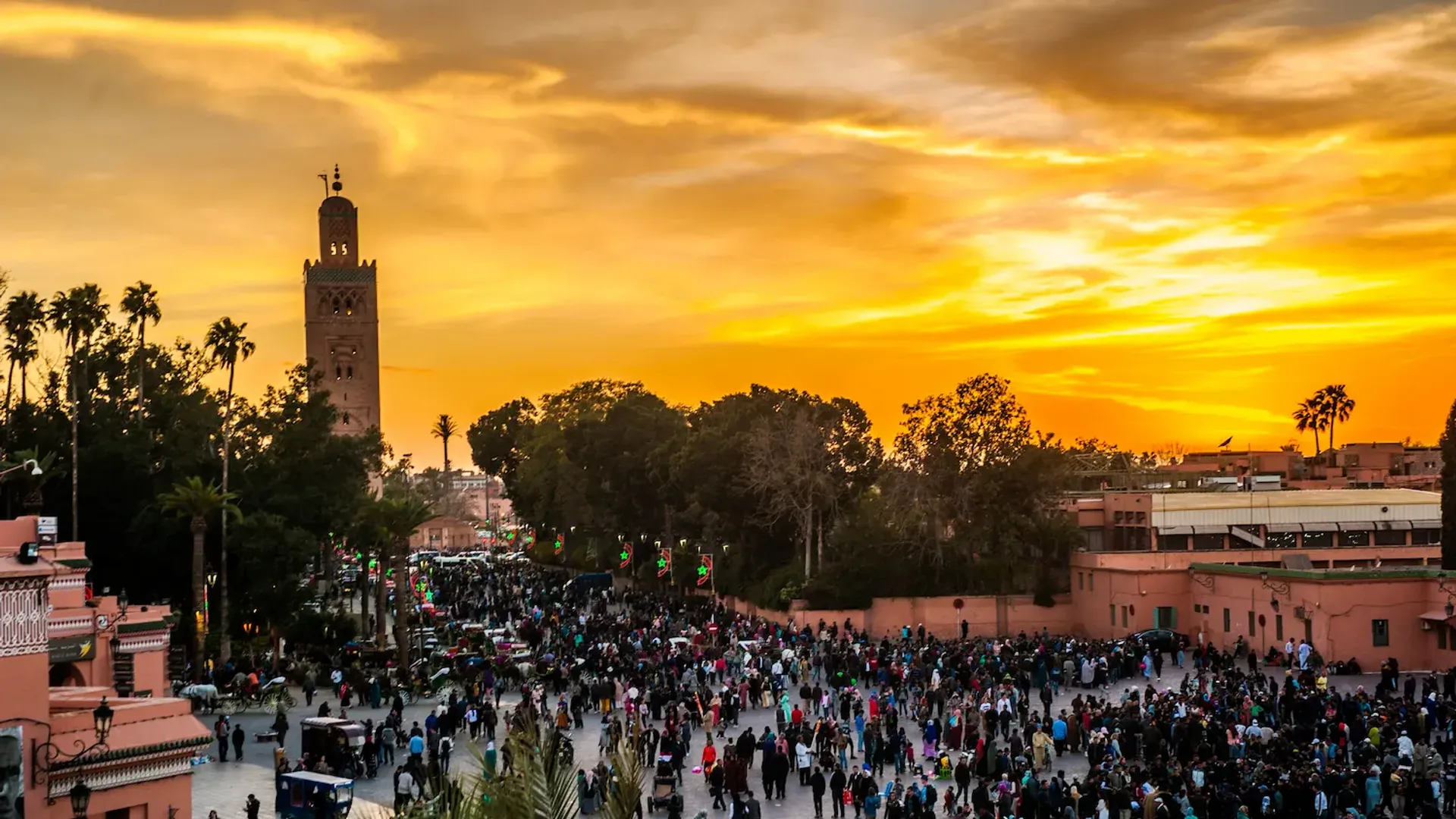
Jemaa el-Fnaa comes alive at dusk, and the transformation is the whole point. From about 5pm the food stalls wheel in and assemble a pop-up open-air restaurant district: rows of numbered kitchens, benches, strung lights and columns of grill smoke rising into the sunset. The gnawa musicians tune their metal castanets, the halqa circles thicken, and by full dark the square is a sea of lamplight and noise that no photograph adequately conveys.
The professional move: take a rooftop first for the aerial view as the lights come on, then descend into it. If you only give Jemaa el-Fnaa one hour of your trip, make it the hour either side of sunset.
Eating at the food stalls
The stalls are numbered, which makes navigation easy — and the selection rule is universal: queue where Moroccan families queue. High turnover means fresh food. Prices are usually displayed; confirm before ordering, and expect a filling run of grilled skewers, harira soup, salads and bread to land around 50–150 MAD per person. The adventurous order babbouche, the peppery snail broth locals drink by the bowl for 10–15 MAD; the classic finish is a slab of sellou or a glass of spiced coffee from the ras el hanout coffee men.
One habit to know: bowls of olives and bread appear "free" at your bench and then appear on the bill. It is convention, not a scam — a few dirhams — but wave them off if you do not want them.
Want to eat through the square with someone who knows every stall's story? Our Marrakech food walking tour runs with a licensed local guide — walking tours start at 900 MAD for one to four guests, with free cancellation up to 48 hours before. Message us on WhatsApp and we will time it for the dusk transformation.
Rooftop views worth the mint tea
The café terraces ringing the square sell the view with the drink. Le Grand Balcon du Café Glacier has the classic elevated panorama towards the Koutoubia; Café de France is the historic alternative. The deal is a purchase — mint tea or juice at 20–40 MAD — and at sunset the front rails fill 30 minutes early, so claim your spot by 6pm in high season.
For the other iconic frame, walk ten minutes west to the Koutoubia gardens. Non-Muslims cannot enter the mosque itself, but the 77-metre minaret floodlit against the last light — with the square's roar behind you — is Marrakech's signature evening image.
Staying comfortable in the crowd
The square is heavily policed and fundamentally safe; the frictions are petty. Dense evening crowds are prime pickpocket territory, so phones go in front pockets and bags across the chest. The square is not fully pedestrianised — scooters thread the edges at all hours, so keep children's hands held at peak crush. Hassle is verbal and commercial, never physical; a smiling, firm "la, shukran" ("no, thank you") ends almost every pitch. Performers who welcome photos expect a tip — 10–20 MAD is right — and agreeing it beforehand keeps everything friendly.
The square anchors any first visit to the city: see how it fits into a full day in our one-day Marrakech itinerary, and prepare for the lanes behind it with our souks shopping guide. If you are basing wider travels here, our private Marrakech tours start at 2,500 MAD per vehicle for up to 9 guests, booked direct with WhatsApp support throughout.
Frequently asked questions
Is Jemaa el-Fnaa safe at night?
Yes — it is busy, well-lit and visibly policed until late, and evening is exactly when you should be there. Treat it like any packed public event: guard pockets in the crush, keep valuables zipped, and agree prices before accepting food, photos or henna.
What time should I visit Jemaa el-Fnaa?
Twice, ideally. Pass through by day for the herbalists and juice carts, then return for the hour either side of sunset, when the food stalls assemble and the square becomes the spectacle it is famous for. The performance energy peaks between 7pm and 10pm.
How much does food cost at the stalls?
A proper feed — skewers, harira, salads, bread, tea — typically runs 50–150 MAD per person. Fresh orange juice is a few dirhams, snail broth 10–15 MAD a bowl. Prices are mostly displayed; confirm before you sit and count your change.
Should I take photos of the snake charmers and monkeys?
We recommend not. The animal-welfare conditions are poor, and any raised camera triggers demands for payment — including from performers you were not photographing. Put your camera budget towards the musicians and storytellers, who represent the square's genuine heritage.