Marrakech Food Tour: What and Where to Eat
Marrakech is one of the world's great street-food cities: smoke rising off the Jemaa el-Fnaa grills at dusk, tanjia pots pulled from the ashes of the hammam furnaces, msemen flipped on hot steel for a few dirhams. This guide covers the dishes worth hunting down, the streets and stalls where locals actually eat them, and how a private food tour with a licensed local guide stitches it all together in one evening.
Why the best food in Marrakech is not in restaurants
Morocco has no Michelin-starred restaurants — and that is a feature, not a failing. The country's cooking lives in homes, market stalls and family-run holes-in-the-wall, and Marrakech is its noisiest, smokiest showcase. The rooftop restaurants around the medina are fine for a sunset drink, but the food that people cross continents for is sold from counters with three stools, hand-painted signs and a queue of locals at lunchtime.
That is exactly why a guide earns their keep here. The gap between a tourist-priced tagine reheated for the fifth time and a tanjia that has cooked overnight in embers is enormous, and the good stalls rarely look like much from the outside. On our Marrakech food walking tour, the guide's job is simple: take you to the counters they eat at themselves, explain what you are eating, and handle the ordering so you can concentrate on the food.
The dishes to hunt down
A few Marrakech essentials to build your eating around — for the full national picture, see our list of 20 Moroccan dishes you must try.
Tanjia is the city's signature: beef or lamb sealed in a clay urn with preserved lemon, garlic, cumin and smen (aged butter), then buried in the hot ashes of the hammam furnace for the best part of a day. It emerges falling apart, eaten with bread and nothing else. Look for it around the Mellah and near the olive souk.
Mechoui is whole slow-roasted lamb, carved from pit ovens in the lane locals call Mechoui Alley, just off Jemaa el-Fnaa. Arrive before 1pm — when the lamb is gone, it is gone.
Harira is the tomato, lentil and chickpea soup that fuels the country, usually 5–10 MAD a bowl with a wedge of bread. Msemen — flaky, layered flatbread griddled to order and eaten with honey or soft cheese — is the breakfast of choice. And the brave should try babbouche, snails in a peppery, herbed broth ladled from steaming cauldrons on the square; a small bowl costs around 10–15 MAD and tastes far better than it sounds.
Jemaa el-Fnaa at dusk: how to work the stalls
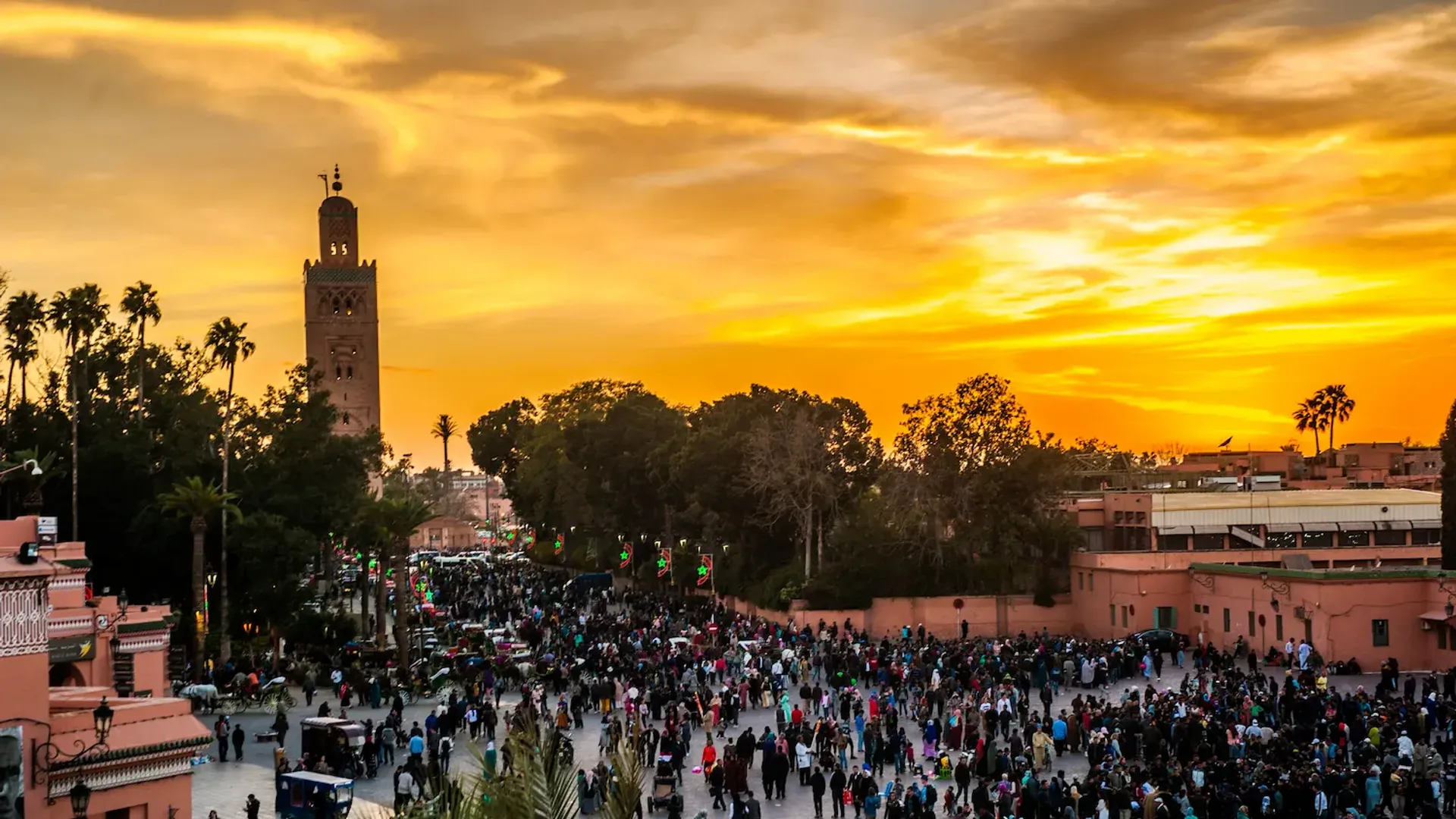
Jemaa el-Fnaa comes alive at dusk. Through the afternoon the square belongs to juice carts and snake charmers, but as the light drops, dozens of numbered food stalls assemble from nothing — trestle tables, benches, gas burners, strings of bulbs — and the smoke starts to rise. This is the single best hour of theatre in Morocco, and you should be standing in the middle of it, hungry.
Work it like a grazing menu rather than a sit-down meal: grilled brochettes and merguez at one stall, a plate of fried aubergine and taktouka at another, kefta with eggs somewhere else. Prices are low — most plates run 30–60 MAD — but confirm them before you order, ignore anyone steering you by the elbow, and favour the stalls where Moroccan families are eating. A fresh orange juice from the carts (about 5–10 MAD) finishes the round properly.
Hungry already? Message us on WhatsApp with your dates and we will hold a private evening on the Marrakech food walking tour — your own licensed guide, no strangers, free cancellation up to 48 hours before the start. Check availability.
Beyond the square: where locals eat by day
The medina rewards daytime grazing too. Around the spice square and the kissaria, hole-in-the-wall counters sell bowls of bissara (silky fava-bean soup, breakfast for a handful of dirhams), sardine-kefta sandwiches, and stewed lentils. The 'mahlaba' milk bars pour avocado smoothies and raib (sweetened set milk) — a welcome pause when the lanes get hot.
Two timing notes matter. First, the souks go quiet around Friday midday, when many family-run stalls close for prayers and couscous at home — Friday is, however, the one day you will find proper couscous served everywhere that does open, since it is the traditional Friday lunch. Second, if your trip falls during Ramadan (which shifts roughly 11 days earlier each year), daytime street food largely disappears, but the hour after sunset — harira, chebakia pastries and dates at the break of the fast — is one of the most atmospheric eating experiences in Morocco.
Mint tea, sweets and the sugar finish
No eating day here ends without mint tea, poured from height until it foams. Pair it with Moroccan patisserie: gazelle-horn pastries stuffed with almond paste, sesame-studded chebakia glistening with honey, and briouats in crisp warqa pastry. The pastry shops of the medina sell by weight, so you can assemble a small box of everything for 20–40 MAD and eat it on a rooftop as the muezzins start the call to prayer.
How our private Marrakech food tour works
This is a private walking tour, not a group shuffle: just your party and a licensed local guide, usually in the evening so you catch Jemaa el-Fnaa lighting up. Our Marrakech walking tours start at 900 MAD for groups of one to four guests, with tiers at 1,200 MAD for five to eight and 1,500 MAD for nine to thirteen — the guide fee, that is, with your food and drink paid directly at the stalls, which rarely comes to more than 100–150 MAD per person even if you eat ambitiously.
Tell us about allergies, vegetarian or halal-curious preferences and spice tolerance when you book, and the route adapts. It pairs naturally with a daytime Marrakech medina walking tour — our curated medina route shows what that day looks like — or with a full private driver day around Marrakech if you want the Palmeraie and Agafay desert in the same trip. Booking is direct, WhatsApp-first, with free cancellation up to 48 hours before a walking tour.
Frequently asked questions
Is the street food in Marrakech safe to eat?
Broadly yes, if you apply the universal rules: eat where turnover is high and locals queue, choose food cooked hot in front of you, and be cautious with anything sitting out. On a guided food tour, stall selection is done for you — our guides skip anywhere they would not eat themselves. Bottled or filtered water is sensible.
How much should I budget for food on Jemaa el-Fnaa?
Very little. Most grilled plates cost 30–60 MAD, soups and snails 5–15 MAD, and fresh juice under 10 MAD. Two people can graze the square thoroughly for around 150–250 MAD total. Confirm prices before ordering and check your change.
What time should a food tour start?
For the full effect, start around 5–6pm: daytime stalls are still trading, and you finish on Jemaa el-Fnaa after dark when the square is at full roar. Morning tours work well too — msemen, bissara and the food souks are at their best before noon — just avoid building a tour around Friday midday, when many stalls close.
Can vegetarians enjoy a Marrakech food tour?
Comfortably. Zaalouk, taktouka, bissara, msemen, vegetable tagines, olives, breads, pastries and the whole juice-and-tea culture are meat-free. Tell us in advance and your guide will build the route around it.