Marrakech Medina Walking Tour: A Curated Route
The Marrakech medina is a walled maze of some 600 hectares, a thousand years old and gloriously indifferent to your map app. Walked well, it is the best single day in Morocco; walked badly, it is four hours of wrong turns and shop touts. This is the route our licensed local guides actually use — palace, madrasa, souks and square, in an order that beats the crowds and ends with Jemaa el-Fnaa at dusk.
Why order matters in the medina
Most visitors do the medina backwards: they start at Jemaa el-Fnaa mid-morning when the square is at its emptiest, hit the souks at peak crush, and reach the monuments queue-deep in tour groups. The curated version inverts that. Monuments early, when the light is best and the coaches have not arrived; souks in the flowing middle hours; the square saved for dusk, when it transforms into the greatest open-air spectacle in North Africa. One planning note: the souks go quiet around Friday midday as family-run stalls close for prayers — a Friday walk is atmospheric but thinner, so shop on another day if the souks are your priority.
Stop 1: the Koutoubia and the southern medina (9:00)
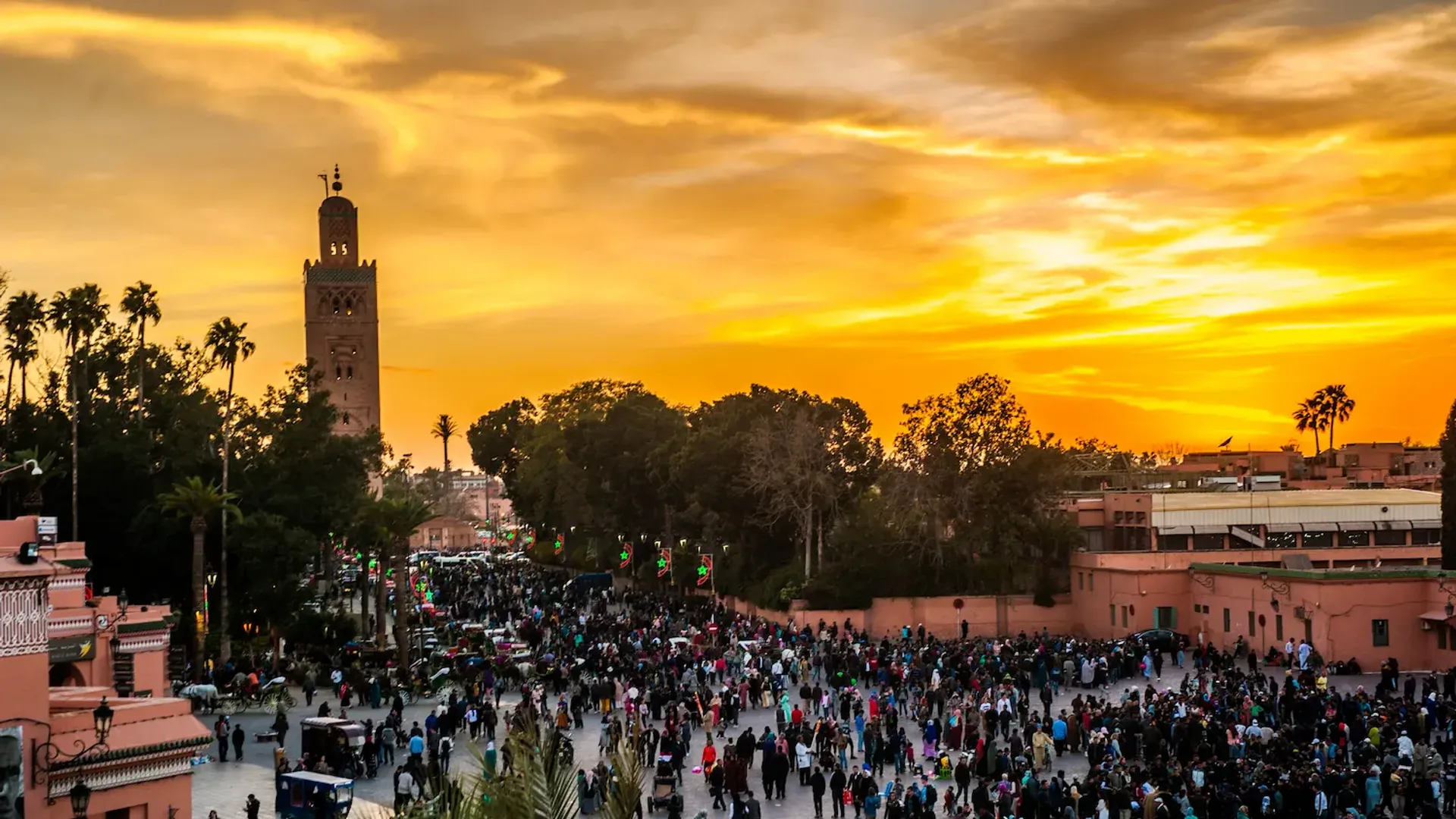
Start outside the walls at the Koutoubia Mosque, whose 77-metre minaret has been the city's compass since the 12th century. Non-Muslims cannot enter the mosque itself, but the gardens beside it are the calmest spot in central Marrakech and the perfect orientation point — from here, everything in the medina is navigated relative to this tower.
Walk south-east into the Kasbah quarter for the Saadian Tombs (entry around 100 MAD), rediscovered in 1917 and home to some of the finest carved cedar and zellij tilework in the country. Arriving at opening means seeing the Chamber of the Twelve Columns with a dozen people instead of a hundred.
Stop 2: Bahia Palace and the Mellah (10:30)
Ten minutes north lies the Bahia Palace (around 100 MAD), 19th-century one-upmanship on a grand scale: eight hectares of painted ceilings, marble courtyards and quiet gardens built to be the greatest palace of its age. It photographs best before the midday glare flattens the courtyards.
From the palace, drift through the Mellah, the old Jewish quarter, with its spice market and the restored Slat al-Azama synagogue. The lanes here are calmer than the central souks and show a different layer of the city's history — this is where a guide moves you from seeing the medina to reading it.
Stop 3: lunch and the artisan souks (12:30)
Cross the medina's midriff towards the spice square, pausing for lunch — a bubbling kefta tagine or a round of Moroccan salads in a local spot, rarely more than 50–90 MAD a head. What to order is a subject we cover properly in 20 Moroccan dishes you must try.
Then the souks, taken as a sequence of trades rather than one undifferentiated bazaar: the dyers' souk with its hanks of drying wool, the metalworkers hammering brass, the leather quarter, the carpenters' lane smelling of cedar shavings. Haggling is expected and good-natured — open at roughly a third of the first price and settle around half — and a guide keeps the pace brisk enough that browsing stays fun rather than becoming a gauntlet.
Rather walk it with someone who grew up here? Our private Marrakech medina walking tour follows this exact route with a licensed local guide — just your group, booked direct on WhatsApp, free cancellation up to 48 hours before the start. Check availability.
Stop 4: Ben Youssef Madrasa (15:00)
At the souks' northern edge stands the Ben Youssef Madrasa (around 100 MAD), the 16th-century Quranic college that is, for many visitors, the most beautiful building in Morocco: a central courtyard of carved stucco, cedar and zellij, ringed by 130 spartan student cells. Mid-afternoon light falls into the courtyard at exactly the right angle. Nearby, the Almoravid Koubba — the only surviving Almoravid structure in the city — is a two-minute detour for the architecturally curious.
Stop 5: Jemaa el-Fnaa at dusk (17:30)
Finish where the medina's energy concentrates. Jemaa el-Fnaa comes alive at dusk: the daytime juice carts give way to storytellers, gnawa musicians, and dozens of food stalls assembling out of nowhere in a rising haze of grill smoke. Take a rooftop café seat facing the square for the transformation (a mint tea buys you the view), then descend into it. If you want to eat the square properly — which stalls, which dishes, what to pay — our Marrakech food tour guide covers exactly that, and the evening food walking tour makes a natural same-day sequel.
Practical details: distance, cost, and booking
The full route covers roughly 6–8 km at an unhurried pace — comfortable shoes matter more than fitness. Entry fees for the three paid monuments total around 300 MAD per person, paid at the door. Carry small cash, drink more water than you think you need, and dress modestly out of respect (shoulders and knees covered travels well everywhere in the medina).
Our private walking tours in Marrakech start at 900 MAD for groups of one to four guests, 1,200 MAD for five to eight, and 1,500 MAD for nine to thirteen — one licensed local guide, your group only, and a route flexed around your interests, whether that is photography, architecture or shopping. Booking is direct and WhatsApp-first, with free cancellation up to 48 hours before a walking tour. If you would rather pair the medina with the Palmeraie, Majorelle and the city's spread-out sights in one day, a private driver day in Marrakech covers the ground walking cannot — and for the garden specifically, read our Jardin Majorelle tickets and tips guide first.
Frequently asked questions
How long does it take to walk the Marrakech medina?
This curated route takes six to eight hours with lunch and monument stops. A compressed half-day version — Bahia Palace, souks, and the square — is possible in three to four hours, and we run both formats.
Is the Marrakech medina safe to walk without a guide?
Yes — petty hassle, not danger, is the issue. Expect persistent shop invitations and 'helpful' youths offering directions to places that turn out to be their uncle's shop. A licensed guide removes all of it, and the difference in what you actually see and understand is substantial.
What should I wear in the medina?
Modest and comfortable: covered shoulders and knees, sturdy shoes for uneven cobbles, a hat and sun cream most of the year. The lanes are shaded but the open squares are fierce from late morning in summer.
Can I do the medina with young children or limited mobility?
With planning, yes. The lanes are stroller-hostile (a carrier works better), and motorbikes share the wider arteries, so a guide who knows the quiet parallel lanes earns their fee. For limited mobility we shorten the loop and build in courtyard rest stops — tell us when you book and we will shape the route accordingly.